
What the job involves on a Huntsville house
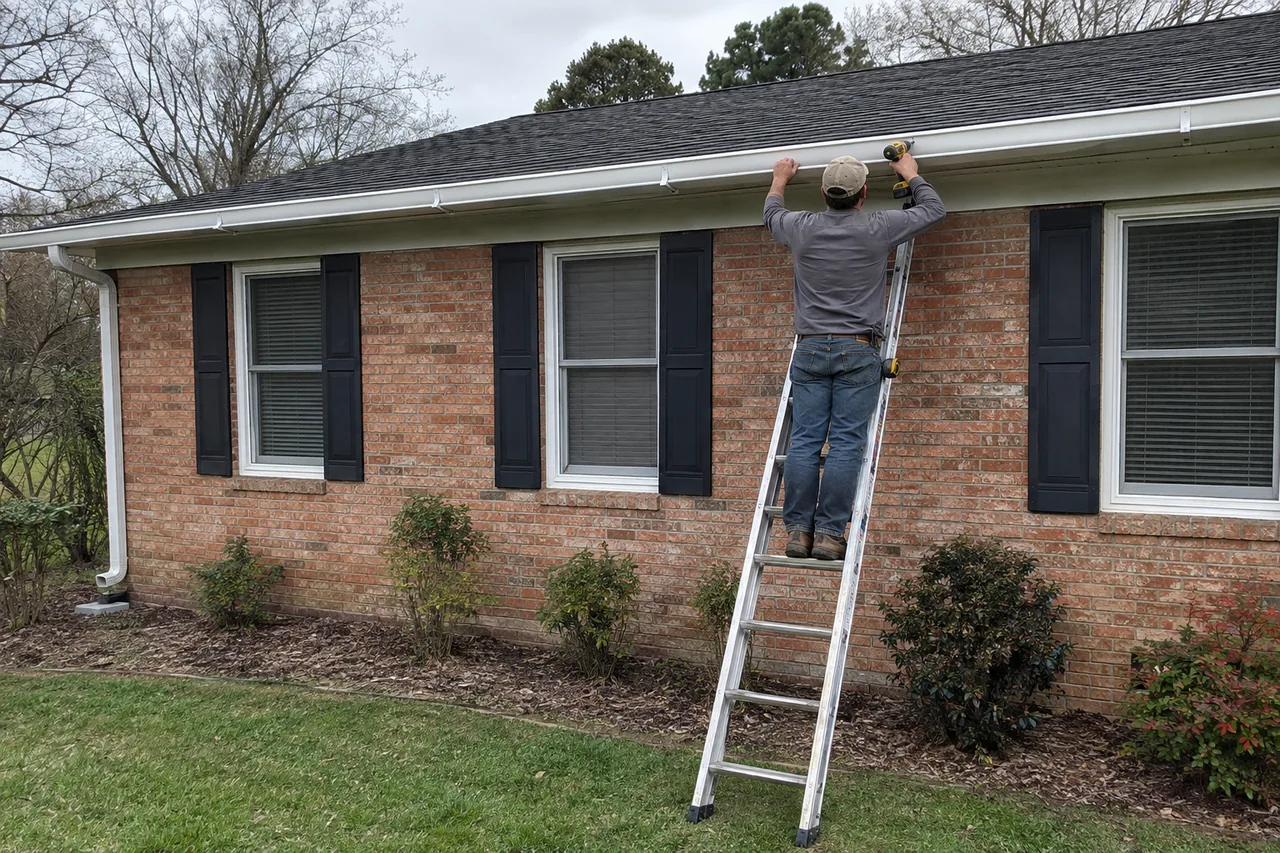
An installer measures each eave, hangs a run of gutter along the fascia under the roof edge, ties it into downspouts, and decides where each downspout lets the water out. Most of what you're paying for is invisible from the street: the size of the trough, the thickness of the metal, the spacing of the hangers, and whether the back of the gutter sits properly under the drip edge.
What makes the job specific to this area is the rain. The National Weather Service's 1991-2020 normals for Huntsville total 54.29 inches a year, with December the wettest month at 5.87 inches. Gutters aren't sized on those totals, though. They're sized on short bursts, and NOAA Atlas 14 puts downtown Huntsville's 5-minute, 10-year rate at 8.20 inches per hour.
Seamless or sectional
This is usually the first choice on a quote. Here's how the published guidance lines up:
| Seamless | Sectional | |
|---|---|---|
| How it's made | Cut on site, with fewer joints | Pieces joined along the run |
| Lifespan (This Old House) | 20 to 30 years | 10 to 15 years |
| Weak point | Fewer joints, but not none, so ask where the remaining ones are | "Higher risk from joints separating over time," in This Old House's words |
| Upkeep | Fewer joints to look after | Bob Vila says aluminum seams need resealing; copper and steel seams are soldered |
| The catch | If a small section can't be patched, the whole run usually gets replaced (HomeAdvisor) | Seams need upkeep over the life of the run |
K-style, half-round, and 5-inch or 6-inch
K-style is the most common residential shape. This Old House says half-round generally carries less volume at the same width, and Angi says it's more commonly used on historic homes, so a half-round run needs its own look at sizing.
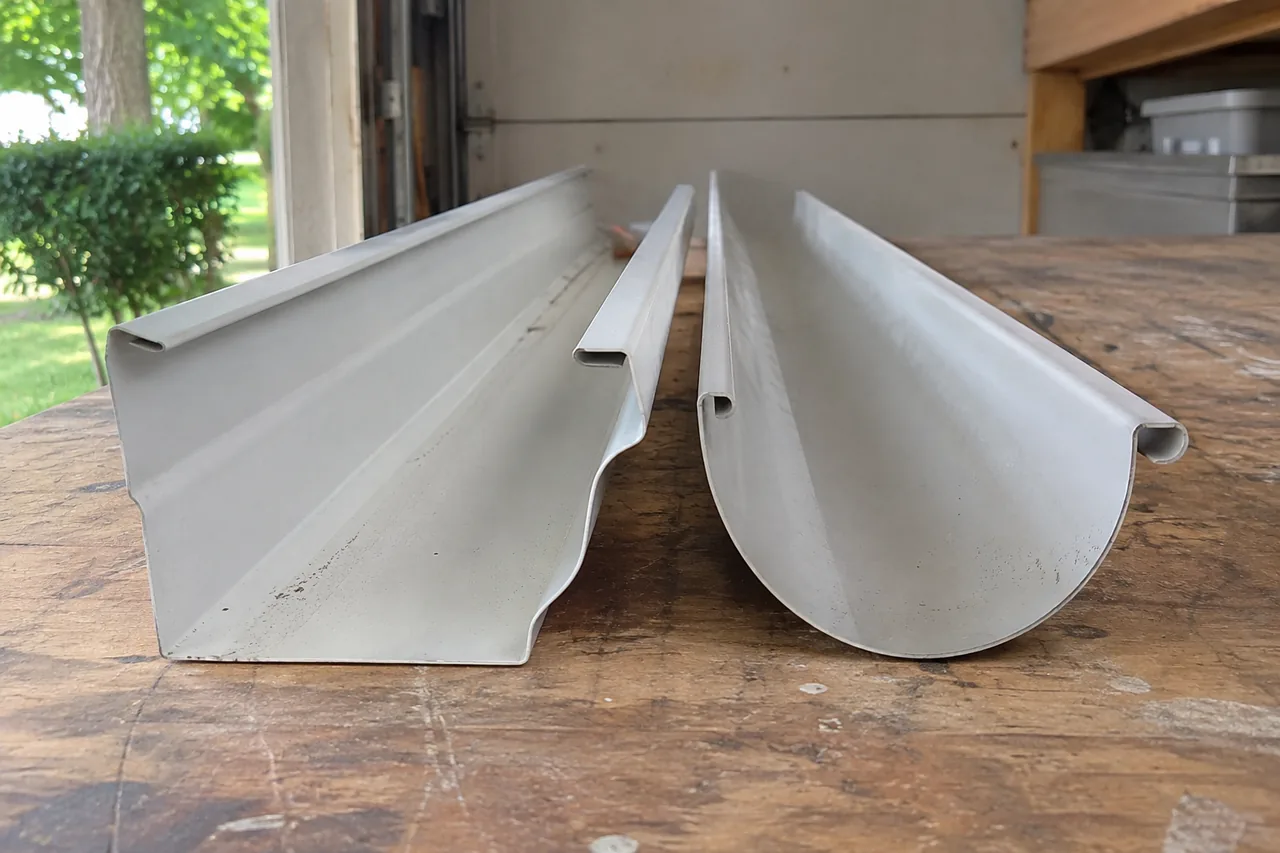
On 5-inch versus 6-inch, the capacity claims don't agree. Angi says 6-inch holds 50% more. An Ohio exterior company's article says 67%, based on gallons held per foot. This Old House's table implies about 44%. Rather than pick one, run the size math on your own eave, which is what the next section does.
Worked example: one rear eave
Assumptions
One rear eave 40 feet long, 15 feet horizontally from eave to ridge, 6-in-12 pitch, one downspout at one end, gutter level. This is teaching math, not a design for your house.
- Plan area: 40 × 15 = 600 square feet.
- Design area with the 6-in-12 pitch factor: 600 × 1.10 = 660 square feet.
- At Huntsville's 8.20 inches per hour, a level 5-inch K-style run serves 673 square feet from one outlet, which barely clears 660. A level 6-inch serves 971.
- At the 100-year rate of 12.8 inches per hour, a level 5-inch serves 431 and a level 6-inch serves 622, so both fall short. A second downspout fixes either one. Pitching fixes the 6-inch (871) but not the 5-inch (604).
The takeaway: the answer turns on the length of each run and the number of downspouts, not just the size of the house. The full method, including the downspout math and a calculator, is in the gutter size guide.
Material and thickness
| Material | Thickness | What to know |
|---|---|---|
| Aluminum | Store stock 0.019 to 0.025 inch; contractors 0.027 or 0.032 | Won't rust; many colors |
| Steel | 24 to 30 gauge, 26 most common | Galvanized rusts after about 20 to 25 years |
| Copper | 16 or 20 ounce | Develops a patina; HomeAdvisor lists about 50 years |
| Vinyl | Not listed | Brittle in cold; about 10 years |
The practical point on aluminum: the thin stock on a store shelf and the thicker coil a contractor forms aren't the same product, so ask which thickness your price is based on. Thickness figures come from Angi and Bob Vila. Copper is an ounces trade, per the copper handbook.
Hangers, slope and downspout spacing
Hangers. Angi says no more than 3 feet apart, and 18 inches or less in rainy locations. On a 40-foot run that's about 14 hangers at 3 feet and about 27 at 18 inches.
Slope. Sources conflict, so no single number is the rule. The U.S. Department of Energy's building science program gives a 1/16 inch per foot minimum. Bob Vila gives 1/2 inch per 10 feet. A forum poster at Green Building Advisor treats 1/4 inch per 10 feet as the minimum, and editors there note that a sloped gutter can open a gap under the drip edge.
Downspout spacing. The Department of Energy program says 20 to 50 feet. Angi says one per 25 to 35 feet, 40 at most. The copper handbook caps a downspout at 50 feet of gutter. This Old House gives runs of 60 feet or more two outlets.
What a sound written quote covers
- The size, shape and material of each run, with the thickness stated.
- How each run was sized, and how many outlets it has.
- Hanger type and spacing.
- Removal and hauling of any old gutters.
- Whether fascia and drip edge get checked first, and how rot would be priced if it turns up.
- Where each downspout discharges.
- Who handles any permit, and what the workmanship warranty says.
Put all of that in a written contract that also shows the contractor's name, address and phone, the work, the dates and the total cost. The hiring guide has more questions to ask.
What commonly goes wrong
A 2015 Fine Homebuilding article on gutter blunders names the usual list: defaulting to 5-inch without checking the roof, too few downspouts, roof shapes that concentrate water in one place, and weak fasteners and sealants. Its advice is short: "Pitch gutters to drain."
Worth checking on your own house: valleys that dump onto one spot, and upper roofs that drain onto lower ones. The worked example above doesn't cover either, and both can push more water into a run than its plan area suggests.
What installation costs
These are national figures, not Huntsville prices. The figures disagree, and the written quote for your house is what counts.
| Source and date | Figure |
|---|---|
| This Old House, updated 10/09/2026 | $600 to $5,800, average $3,200, on a typical 2,000-square-foot home (about 200 feet of gutter) |
| This Old House seamless, updated 10/13/2026 | Average $1,984 for 200 feet |
| Bob Vila, June 9, 2023, HomeAdvisor data | $622 to $1,677, average $1,135 |
| Angi seamless, "2025 Data" | $650 to $1,700, average $1,150; 6-inch adds $3 to $5 per foot |
The cost guide has per-foot prices by material and explains why these numbers are so far apart.
When installation isn't the right call
- The gutters are sound but overflow in the fall. They may just be clogged. Start with cleaning.
- One joint leaks or one stretch sags. That's usually a repair.
- Water is pooling in the yard. The problem may be where it lands, not how it's collected. See downspouts and drainage.
- The house is in a Huntsville historic district. Talk to Historic Preservation before you sign anything.
Permits
No agency page read for this site says whether gutter work needs a permit, in any local jurisdiction, so the honest advice is to call and ask. Huntsville Inspection: 256-427-5331. Madison Building Department: 256-772-5644. Madison County Inspection, for unincorporated addresses: 256-746-2950.
Questions homeowners ask
Do seamless gutters really leak less?
They have fewer joints, and sectional gutters' joints can separate over time, which is the main argument for seamless. Fewer isn't none, though, so ask where the remaining joints will be and how they're sealed.
Is 5-inch enough, or is clogging the real issue?
It can be either. If a clean gutter still overflows in hard rain, sizing and outlets are worth checking with the calculator. If it overflows mainly when full of leaves, start with cleaning.
Will 6-inch gutters look too big on my house?
That's a matter of taste, and no source read settles it. Ask to see a sample piece held up at the eave before you decide. A second downspout on a 5-inch run is the other way to add capacity.
How long will new gutters last?
This Old House gives 20 to 30 years for seamless and 10 to 15 for sectional. HomeAdvisor says aluminum or galvanized lasts about 20 years. Vinyl runs about 10 and copper about 50.
Do I need a permit for new gutters here?
Call your jurisdiction. The numbers are in the section above. The local pages read for this site don't settle it either way.
How this site helps: it passes your request to one independent local contractor, and it does no gutter work itself.
Related guides
Sources
- National Weather Service Huntsville normals, 1991-2020. The page says its data "are not considered official data."
- NOAA Atlas 14, Vol. 9, downtown Huntsville. Values move slightly by address.
- This Old House, seamless gutters, updated 10/13/2026; sizes, updated April 20, 2026; how to size, updated April 20, 2026.
- Bob Vila, gutter basics, modified August 20, 2021.
- HomeAdvisor, gutter repair, undated.
- Building America Solution Center, gutters and downspouts, updated September 26, 2021.
- Fine Homebuilding, sizing method, undated.