
What this work involves here
Downspout work can mean adding an outlet to a long run, upsizing a downspout, extending a discharge, or running water underground to an outlet farther from the house. Huntsville gives this plenty to do. The National Weather Service's account of a December 2015 storm reads: "3-9 Inches of Rainfall fell December 24th - 26th." Even in normal years, rain totals 54.29 inches. All of it comes off the roof at the downspouts, in only a few spots around the house.
How far apart downspouts should be
Sources conflict, so don't take any one number as the rule:
| Source | Guidance |
|---|---|
| Department of Energy's Building America Solution Center | 20 to 50 feet apart |
| Angi | One per 25 to 35 feet, 40 at most |
| Copper trade handbook | At most 50 feet of gutter per downspout; 7 square inches minimum, except for small areas |
| This Old House | Runs of 60 feet or more get two outlets |
Spacing rules are shortcuts. The sizing math below tells you more about your own roof.
Worked numbers: how big a downspout
Assumptions
A design area of 660 square feet, from a 40-foot rear eave, 15 feet to the ridge, at 6-in-12 pitch. One downspout. The copper handbook's rule: at 1 inch per hour, each square inch of downspout drains 1,200 square feet, and doubling the rain rate halves that. Rain rates are NOAA's for downtown Huntsville.
| Rain rate | Sq ft per sq in | Needed for 660 sq ft |
|---|---|---|
| 8.20 in/hr (5-minute, 10-year) | 146 | 4.5 sq in |
| 12.8 in/hr (5-minute, 100-year) | 94 | 7.0 sq in |
| Rule of thumb: 100 sq ft per sq in | 100 | 6.6 sq in |
A 2x3 downspout nominally has 6 square inches and a 3x4 has 12, and the actual area of a corrugated or rounded downspout may be less. So on this eave, a 2x3 clears the 10-year rate, and it falls short of the 100-year rate. This is teaching math, not a design. Elbows aren't counted.
How far out the water should land
The Department of Energy program says to discharge "at least 5 feet from the foundation" and catchment systems at least 10 feet away. Bob Vila says standard downspouts discharge only 1 to 3 feet out, which is often not enough on poorly draining soil.
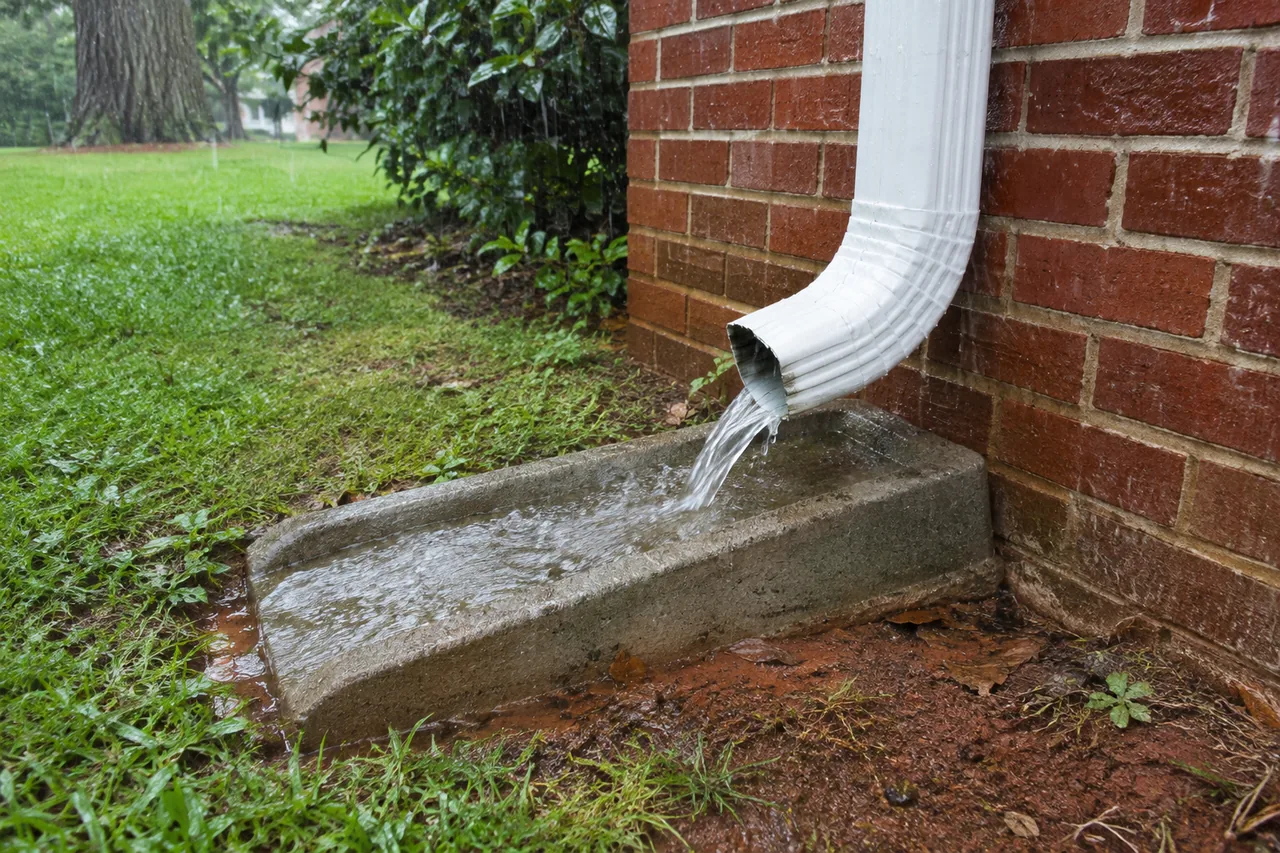
Unincorporated Madison County's Lot Drainage Inspection Information Sheet has a local line: "Roof drains directed a minimum 5' away from home." It's a lot-drainage inspection item, so it's the county's stated standard for that inspection, not a rule on every existing home. The same sheet asks for a "minimum of 6" within the first 10 feet" of grade.
About the soil. Red clay soils are real in the Tennessee Valley, but don't assume they're what's holding water at your house. The federal description of the Decatur series, an extensive red soil here, reads "Well drained. Runoff is medium, and permeability is moderate." More on the rain, storms and soil page.
Your options, shortest to longest
| Option | Suits | Watch for | Published price |
|---|---|---|---|
| Splash block | A run where 1 to 3 feet is enough | Doesn't move water far | About $10 (Bob Vila); $6 to $66 retail (This Old House) |
| Extension | Getting to 5 feet | Check how far it really reaches against the 5-foot guidance | $10 to $50, plus $30 to $100 labor (Bob Vila) |
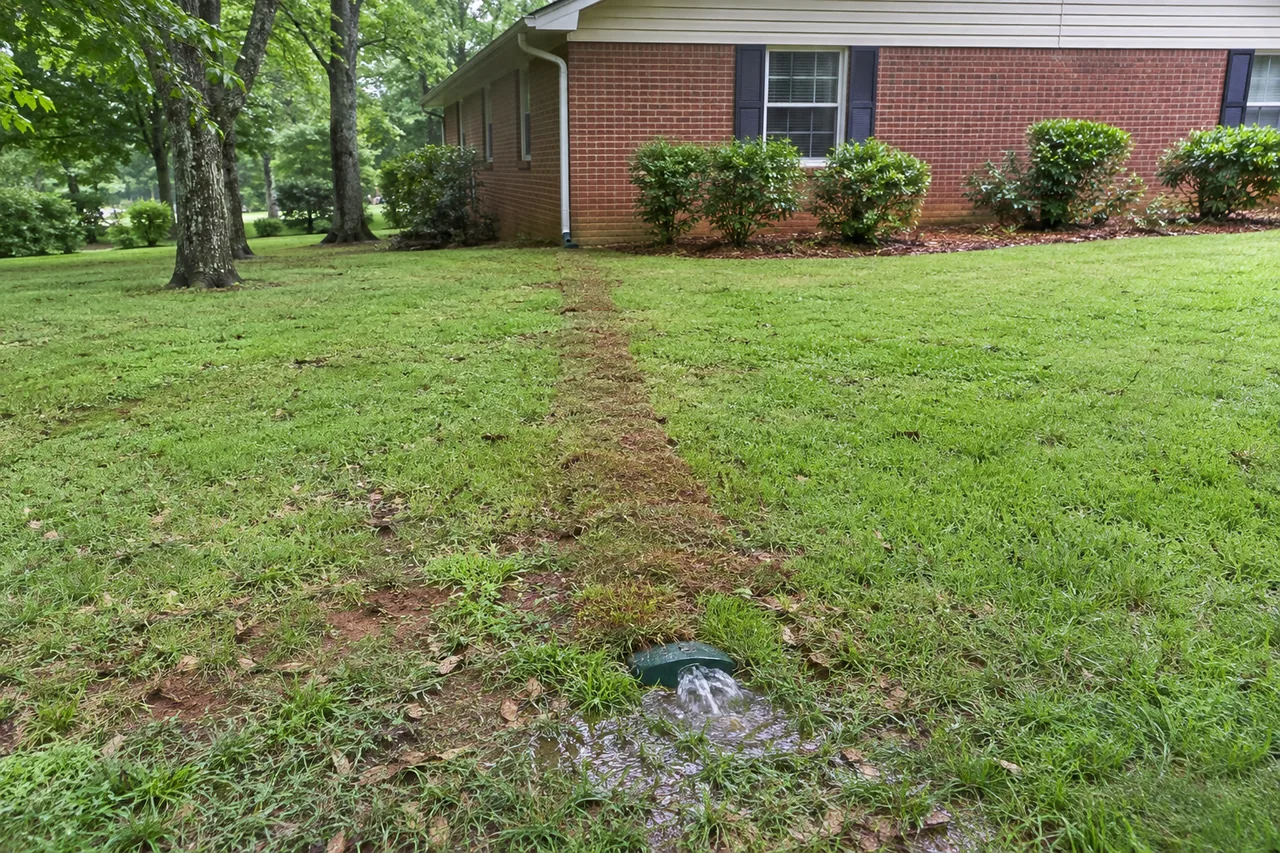
| Pop-up emitter | Poor drainage or grading, per Bob Vila | Needs a buried line. More serious problems may need French drains | Not found |
| Underground line | Discharge farther from the house | Needs slope; can clog | No reliable source found. Ask |
For underground pipe, the Department of Energy program gives a slope of at least 0.5 inch per foot for at least 10 feet. On 10 feet of pipe, that's at least 5 inches of fall, which you can roughly judge in your own yard before anyone digs.
What goes wrong
- Buried lines. A waterproofing company's article lists clogs, poor slope or outlets, roots, pipe damage and freezing. That company sells this work, so read it as a claim. It's still a good list of questions.
- Too few outlets for a long run. A 2015 Fine Homebuilding article lists too few downspouts among common mistakes.
- Removing an outlet after upsizing. Doubling the downspouts doubles the area a run can serve, so removing one halves it. Worked below.
- Altered drainage. Madison County's sheet says landscaping must not alter drainage structures critical to a subdivision's stormwater plan.
Worked numbers: dropping the downspout over the walkway
Assume a roof section with a design area of 1,000 square feet, and 5-inch K-style gutter, level, at 8.20 inches per hour. With two outlets it serves 2 × 673 = 1,346 square feet. Now go to 6-inch and drop one outlet: 971 square feet, which falls short of 1,000. In other words, a bigger gutter doesn't fully replace a removed outlet here.
Neighbors, streets and low spots
No ordinance read for this site says where a house downspout may discharge in Huntsville or Madison, and the Huntsville code couldn't be read. So this site can't tell you a rule about pointing a downspout at a sidewalk, a street or a neighbor's yard. Here's who to call:
- City of Madison: Engineering, 256-772-5639, assesses drainage issues first, and the city's FAQ says "if there is a violation, Code Enforcement will get involved."
- City of Huntsville: report non-emergencies through Huntsville Connect. Engineering is listed at 256-427-5300 on a 2019 city page. The city says "more than 90 percent of drainage complaints come from residents not in the floodplain", and that many drainage issues occur on "properties located on the sides of local mountains."
- Unincorporated Madison County: Public Works is "responsible for managing stormwater and drainage in unincorporated Madison County." This site couldn't load a phone number for it, so check the county's site or ask County Inspection at 256-746-2950 which office to call.
The Madison County sheet also mentions "Side lot line swales to direct lot drainage". If a shared swale runs along your side lot line, don't fill it or block it without asking the county first.
A depression near where a downspout empties
North Alabama is "dappled with sinkholes, springs, and cave openings", according to the Geological Survey of Alabama, and its page lists drainage problems and excessive rainfall among causes. No source ties gutters to causing or stopping a sinkhole. If water from a downspout is concentrating near a depression, that's worth raising with the city or the county, not something for a gutter contractor to rule on.
When this isn't a downspout problem
- Water comes from the street or a neighbor's lot in volume. Call the city or county drainage contacts above.
- The lot itself is graded toward the house. Bob Vila says more serious problems may need French drains, which is a different kind of job.
- The gutter overflows before water reaches the downspout. Check for clogs, then the sizing.
Permits
No agency page read says whether downspout or drainage work needs a permit. Call the office for your address: Huntsville Inspection at 256-427-5331, Madison Building at 256-772-5644, or Madison County Inspection at 256-746-2950. The hiring guide includes a question about where each downspout discharges.
Questions homeowners ask
Can I remove the downspout that dumps across my walkway if I go bigger?
Run the numbers first. In the example above, the swap falls short. An underground line or a rerouted outlet may be the better question to ask.
Can my neighbor's downspout drain onto my yard?
No rule read for this site answers that. Call Madison Engineering, Huntsville Connect or Madison County Public Works, depending on your address. Beyond that, it's a question for a lawyer.
Is 5 feet from the foundation a legal requirement?
The Department of Energy program gives it as guidance. Madison County's sheet applies it to its lot drainage inspection. This site doesn't treat the International Residential Code's text as a rule for existing homes, since the code itself wasn't readable.
Can downspouts drain into a buried pipe?
They can, if the pipe slopes. The Department of Energy program gives at least 0.5 inch per foot for at least 10 feet. Ask where the outlet will be and how you'd clear a clog.
Can I sweep gutter debris into the street?
Don't. Huntsville's Ordinance 21-311 notice makes street-side curb gutters the owner's or occupant's job to keep clear on residential streets in 25 mph zones, so debris pushed to the curb stays your problem. Public Works: 256-883-3609, per that 2019 notice.
How this site helps: your request goes to one independent local contractor. Drainage questions about neighbors or streets belong with the offices above.
Related guides
Sources
- Building America Solution Center, updated September 26, 2021; Building Science Education Solution Center, undated.
- Madison County, Lot Drainage Inspection Information Sheet, undated; stormwater management, undated.
- City of Madison, FAQs, undated.
- City of Huntsville, flooding myths, and drainage reporting, both modified December 3, 2019; curb gutter notice, November 11, 2019.
- Bob Vila, pop-up emitters, modified September 22, 2020; installation cost, modified June 9, 2023.
- This Old House, installation cost, updated 10/09/2026; how to size, updated April 20, 2026.
- Copper trade handbook, gutters and downspouts.
- Fine Homebuilding, common gutter blunders, 2015.
- A waterproofing company's article on buried downspouts, February 10, 2025. It sells this work.
- USDA, Decatur soil series, revised October 2004; Geological Survey of Alabama, sinkholes, undated; National Weather Service, December 2015 rain; NOAA Atlas 14.